








For groups of brands
Many brands. One company.
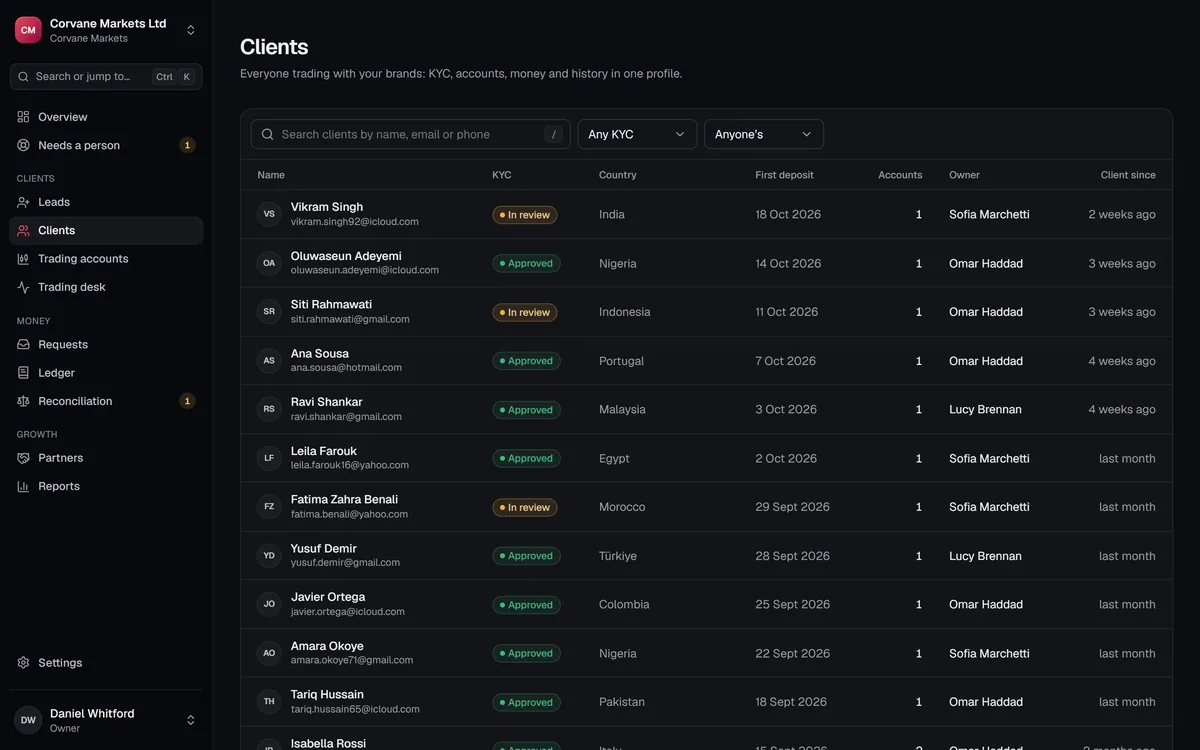
Each brand has its own portal, domain, look, payment details, approval threshold, account types and IB plans. Your staff see every brand or only the ones you choose, and the database enforces it.
Per brand
What each brand keeps to itself.
A portal and its address, a look, payment details, an approval threshold, account types, IB plans and a sending address. Switch between the two brands to see what changes, and who can see it.
One company, two brands
Example- Portal address
- client.corvanepro.com
- Look
- Terminal preset, IBM Plex, sharp corners
- Approval threshold
- 5,000 USD
- Account types
- Pro ECN, Demo
- IB plans
- Pro Partner
- Payment details
- USD bank details
- Mail from
- desk@corvanepro.com
- MT5 groups
- real\pro\*
Both brands share the server Corvane-Live, one connection each. The desk keeps to each brand's own groups.
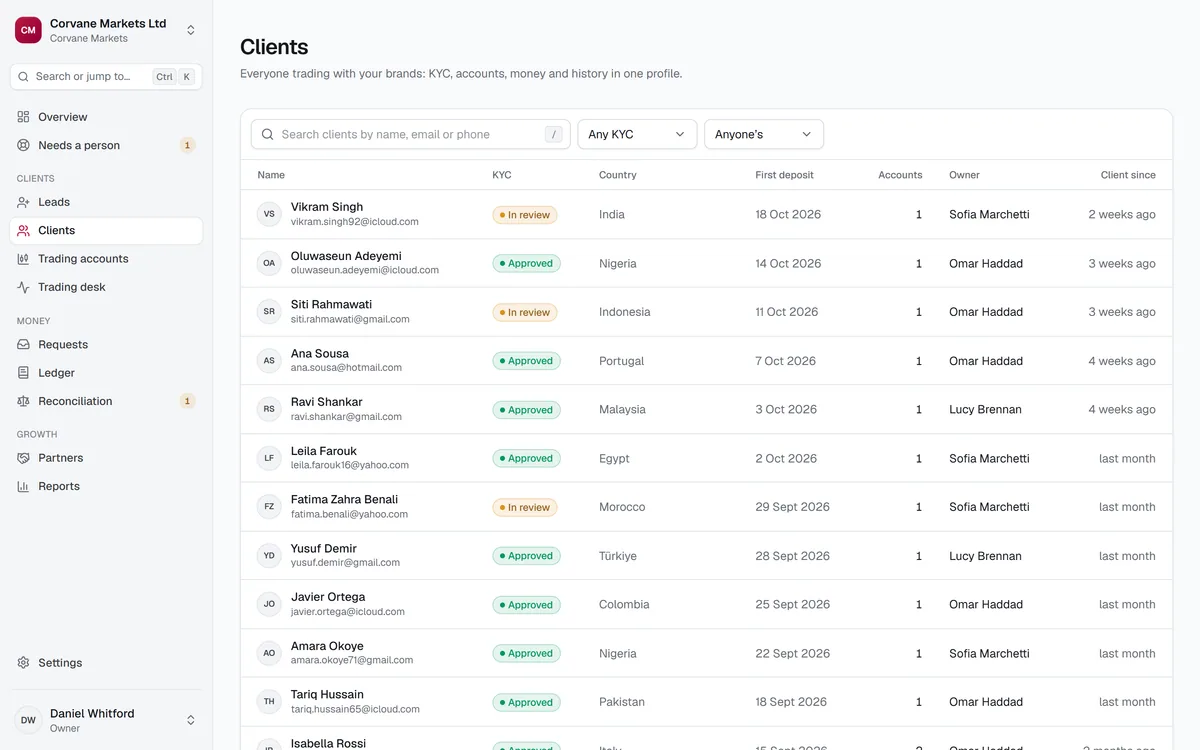
Who sees Corvane Pro
- Daniel Whitford OwnerSees its clients
- Sofia Marchetti FinanceSees its clients
- Omar Haddad SupportSees its clients
Enforced by row-level security in the database, not by hiding things on a screen.
MT5 servers
Two brands, one server, no mix-ups.
Brands and servers don't have to match one to one. The lines between them are drawn by groups, and kept by the bridge.
- 01
One connection per brand
Each brand has one MT5 connection of its own, with its own account types built on its own groups. - 02
Two brands, one server
Two brands may share a server. The trading desk keeps to each brand's own groups. - 03
An account stays where it opened
A trading account belongs to the server it opened on. - 04
Moving a connection starts clean
Pointing a connection at another server clears its mirror, so the desk never shows one server's accounts as another's.
Your staff
Access, person by person.
One company, one sign-in for your team, and each person kept to the brands they work on.
- 01
Every brand, or the ones you choose
Staff get every brand or chosen ones, and row-level security in the database enforces it. It covers 58 tables. - 02
30 permissions, 9 roles
A person can hold up to 10 roles. "Who can do what" shows their combined rights, so nobody has to add them up. - 03
Approvals stay per brand
Each brand's own threshold decides when a second person is needed, and the 14-day block follows each client.
Each brand's mail
Every brand signs its own mail.
Each brand enters its own From address. GarnetSync shows the records to add, and verifies three things before it sends from it.
 Brevo
- RecordsOur proof TXT, Brevo's code, DKIM and DMARC, shown for the brand's own domain.
- VerifiedThe proof found, Brevo's check passed, and a 6-digit code sent to the address and entered back.
- Until thenClients get mail in the brand's name from a neutral address.
- AfterThe records are checked again every 15 minutes for a week, then daily, and managers are emailed if they stop passing.
A free mailbox is refused, in the product's own words: "Use an address on your own domain: free mailbox providers can't be authenticated."
Where to next
Every brand keeps its own rules.
Thresholds, partner plans and payment details are set per brand. See how each module keeps to the line between them.